Prerequisites
This notebook reuses tables created by other example notebooks. Run them first:
Train autoencoder for embedding extraction
This notebook showcases more ways of working with metrics and embeddings in 3LC. It is mostly meant as a demonstration of how to collect embeddings and image metrics from a manually trained model.
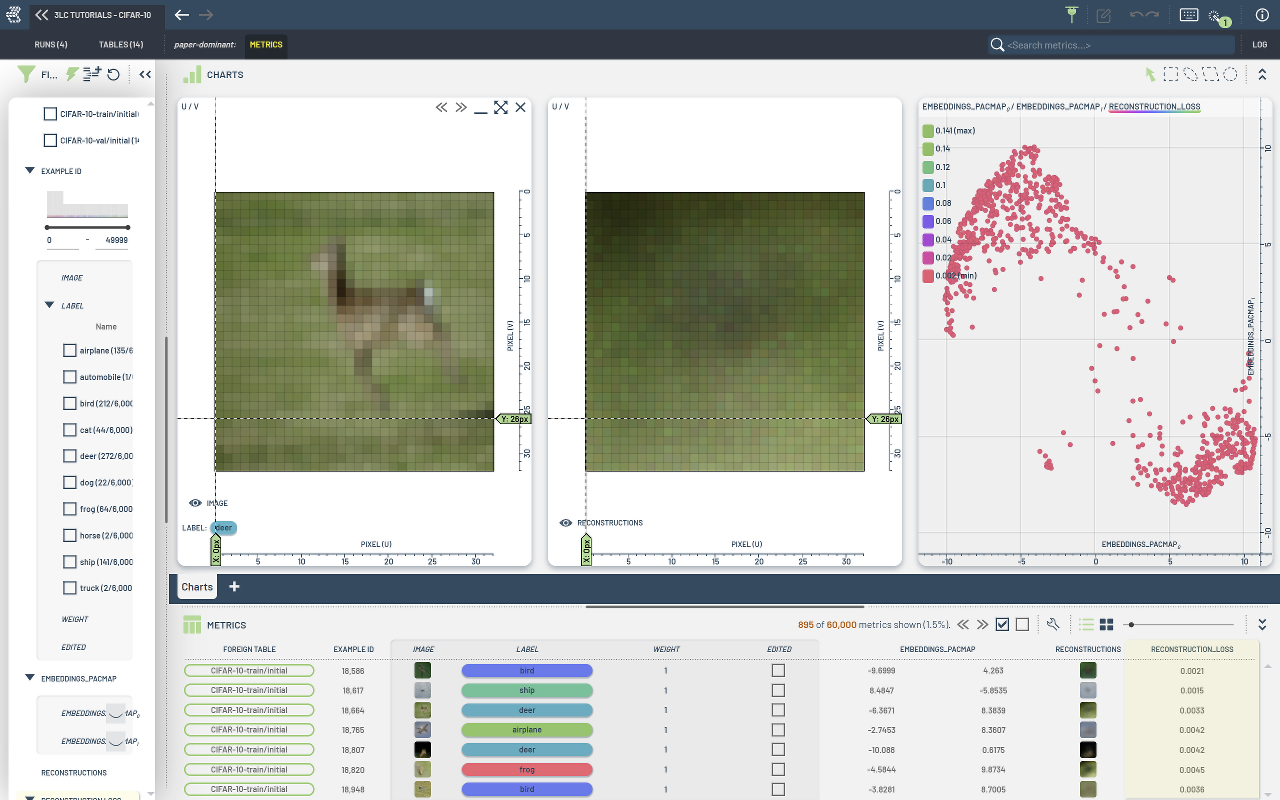
The auto-encoder architecture is mainly used as a simple example to demonstrate the process, and the model should only be considered as an example of an embedding extractor, which also produces images as a side effect.
Project setup
[ ]:
TMP_PATH = "../../transient_data"
PROJECT_NAME = "3LC Tutorials - CIFAR-10"
RUN_NAME = "Train autoencoder"
RUN_DESCRIPTION = "Train an autoencoder and collect embeddings and reconstructions"
AUTOENCODER_BACKBONE = "resnet50"
EMBEDDING_DIM = 512  # Desired embedding dimension
EPOCHS = 10
FREEZE_ENCODER = False
IMAGE_WIDTH = 32
IMAGE_HEIGHT = 32
NUM_CHANNELS = 3
BATCH_SIZE = 64
METHOD = "pacmap"
NUM_COMPONENTS = 2
NUM_WORKERS = 0
INSTALL_DEPENDENCIES = True
Install dependencies
[ ]:
if INSTALL_DEPENDENCIES:
    %pip install -q 3lc[pacmap]
    %pip install -q git+https://github.com/3lc-ai/3lc-examples.git
    %pip install -q timm
Imports
[ ]:
import tlc
import torch
import torch.nn as nn
from timm import create_model
from torch.utils.data import DataLoader
from torchvision import transforms
from tqdm.auto import tqdm

from tlc_tools.common import infer_torch_device
[ ]:
CHECKPOINT_PATH = TMP_PATH + "/autoencoder_model.pth"
Load input Table
[ ]:
train_table = tlc.Table.from_names(
    table_name="initial", dataset_name="CIFAR-10-train", project_name="3LC Tutorials - CIFAR-10"
)
val_table = tlc.Table.from_names(
    table_name="initial", dataset_name="CIFAR-10-val", project_name="3LC Tutorials - CIFAR-10"
)
[ ]:
# Prepare Data
transform = transforms.Compose(
    [
        transforms.ToTensor(),
    ]
)


def map_fn(sample):
    """Map samples from the table to be compatible with the model."""
    image = sample["Image"]
    image = transform(image)
    return image


train_view = train_table.with_transform(map_fn)
val_view = val_table.with_transform(map_fn)
Train autoencoder
[ ]:
class Autoencoder(nn.Module):
    def __init__(self, backbone_name="resnet50", embedding_dim=512, freeze_encoder=FREEZE_ENCODER):
        super().__init__()

        # Load the backbone as an encoder
        self.encoder = create_model(backbone_name, pretrained=True, num_classes=0)
        encoder_output_dim = self.encoder.feature_info[-1]["num_chs"]

        # Freeze encoder parameters if specified
        if freeze_encoder:
            for param in self.encoder.parameters():
                param.requires_grad = False

        # Add a projection layer to reduce to embedding_dim
        self.projector = nn.Linear(encoder_output_dim, embedding_dim)

        # Define the decoder
        self.decoder = nn.Sequential(
            nn.Linear(embedding_dim, encoder_output_dim),
            nn.ReLU(),
            nn.Linear(encoder_output_dim, IMAGE_HEIGHT * IMAGE_WIDTH * NUM_CHANNELS),
            nn.Sigmoid(),
        )

    def forward(self, x):
        # Encoder
        features = self.encoder(x)
        embeddings = self.projector(features)

        # Decoder
        reconstructions = self.decoder(embeddings)
        reconstructions = reconstructions.view(x.size(0), NUM_CHANNELS, IMAGE_WIDTH, IMAGE_HEIGHT)
        return embeddings, reconstructions
[ ]:
# Initialize the model
model = Autoencoder(backbone_name=AUTOENCODER_BACKBONE, embedding_dim=EMBEDDING_DIM)

# Training Components
criterion = nn.MSELoss()  # Reconstruction loss
optimizer = torch.optim.Adam(model.parameters(), lr=1e-4)

# Create data loaders over the views (which apply the transform on read)
train_loader = DataLoader(train_view, batch_size=BATCH_SIZE, shuffle=True)
val_loader = DataLoader(val_view, batch_size=BATCH_SIZE, shuffle=False)

device = infer_torch_device()
model.to(device)
[ ]:
# Training loop
for epoch in range(EPOCHS):
    model.train()
    epoch_train_loss = 0.0
    epoch_val_loss = 0.0

    for images in tqdm(train_loader, desc="Training", total=len(train_loader)):
        images = images.to(device)

        # Forward pass
        embeddings, reconstructions = model(images)

        # Compute loss
        loss = criterion(reconstructions, images)

        # Backward pass and optimization
        optimizer.zero_grad()
        loss.backward()
        optimizer.step()

        epoch_train_loss += loss.item()

    # Validation pass
    model.eval()
    with torch.no_grad():
        for images in tqdm(val_loader, desc="Validation", total=len(val_loader)):
            images = images.to(device)

            # Forward pass
            embeddings, reconstructions = model(images)

            # Compute loss
            loss = criterion(reconstructions, images)

            epoch_val_loss += loss.item()

    epoch_train_loss /= len(train_loader)
    epoch_val_loss /= len(val_loader)

    print(f"Epoch [{epoch + 1}/{EPOCHS}], Train Loss: {epoch_train_loss:.4f}, Val Loss: {epoch_val_loss:.4f}")
[ ]:
# Save the model
torch.save(model.state_dict(), CHECKPOINT_PATH)
print(f"Model saved to {CHECKPOINT_PATH}")
Collect metrics from the trained model
[ ]:
unreduced_loss = nn.MSELoss(reduction="none")  # Reconstruction loss


def metrics_fn(batch, predictor_output):
    embeddings, reconstructions = predictor_output.forward
    reconstructed_images = [transforms.ToPILImage()(image.cpu()) for image in reconstructions]
    reconstruction_loss = unreduced_loss(reconstructions.to(device), batch.to(device)).mean(dim=(1, 2, 3))
    return {
        "embeddings": embeddings.cpu().detach().numpy(),
        "reconstructions": reconstructed_images,
        "reconstruction_loss": reconstruction_loss.cpu().detach().numpy(),
    }
[ ]:
run = tlc.init(project_name=PROJECT_NAME, run_name=RUN_NAME, description=RUN_DESCRIPTION)

tlc.collect_metrics(
    train_view,
    metrics_fn,
    predictor=model,
    collect_aggregates=False,
    dataloader_args={"batch_size": BATCH_SIZE, "num_workers": NUM_WORKERS},
)

tlc.collect_metrics(
    val_view,
    metrics_fn,
    predictor=model,
    collect_aggregates=False,
    dataloader_args={"batch_size": BATCH_SIZE, "num_workers": NUM_WORKERS},
)
Reduce embeddings to 2D
[ ]:
run.reduce_embeddings_by_foreign_table_url(
    train_table.url,
    source_embedding_column="embeddings",
    method=METHOD,
    n_components=NUM_COMPONENTS,
)