Fine-tuning a SegFormer model with Pytorch Lightning
This notebook fine-tunes a SegFormer model for semantic segmentation using PyTorch Lightning.
The original notebook can be found here.
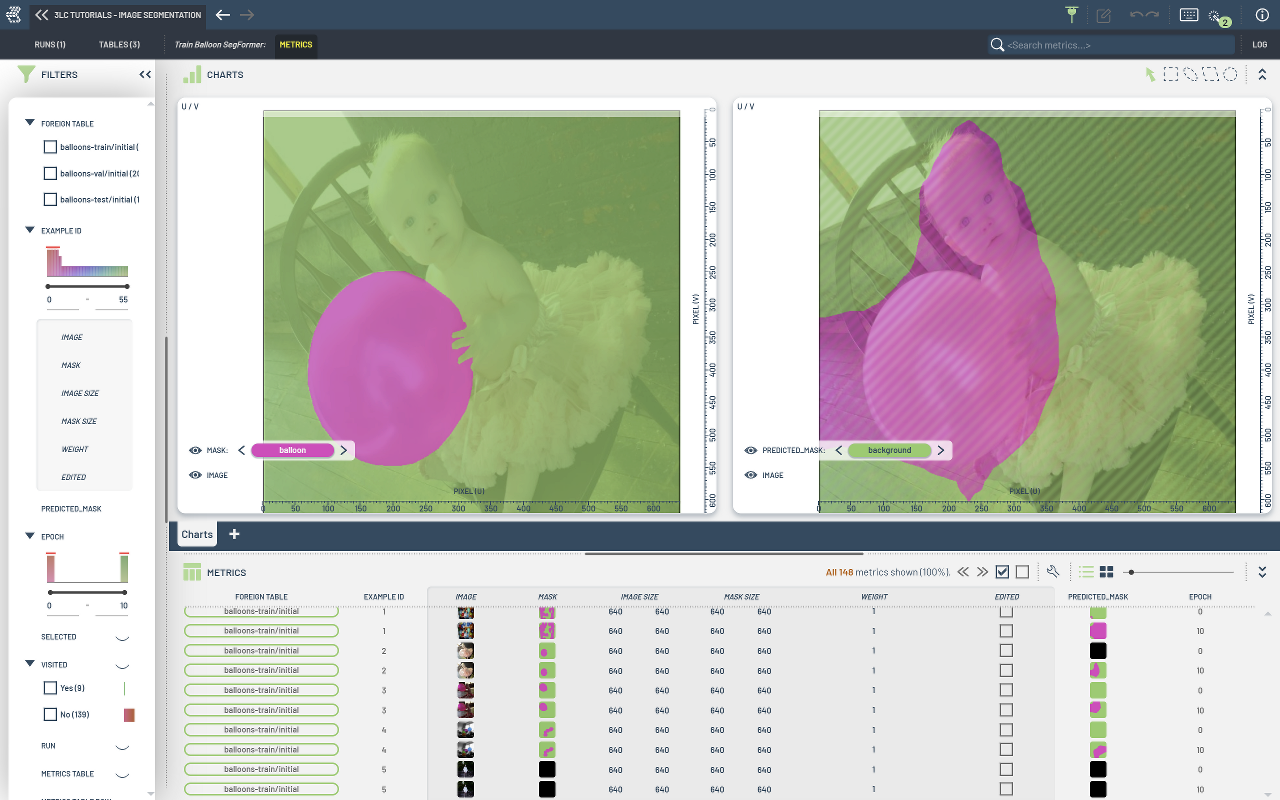
In this tutorial we fine-tune a pre-trained SegFormer model for semantic segmentation on a custom dataset. We integrate with 3LC by creating Tables up front, initializing a Run, and collecting per-sample predicted masks from raw Lightning hooks.
This notebook demonstrates:
Training a SegFormer model on a custom dataset with PyTorch Lightning.
Registering train/val/test sets into 3LC Tables.
Collecting per-sample semantic segmentation predicted masks via
tlc.collect_metricscalled fromon_train_epoch_end/on_train_end.
Project Setup
[ ]:
PROJECT_NAME = "3LC Tutorials - Image Segmentation"
RUN_NAME = "Train Balloon SegFormer"
DESCRIPTION = "Train a SegFormer model using PyTorch Lightning"
TRAIN_DATASET_NAME = "balloons-train"
VAL_DATASET_NAME = "balloons-val"
TEST_DATASET_NAME = "balloons-test"
SEGFORMER_MODEL_ID = "nvidia/mit-b0"
DATA_PATH = "../../data"
EPOCHS = 10
BATCH_SIZE = 8
NUM_WORKERS = 0
DEVICE = None
LEARNING_RATE = 2e-05
INSTALL_DEPENDENCIES = True
Install dependencies
[ ]:
if INSTALL_DEPENDENCIES:
    %pip install -q 3lc[huggingface]
    %pip install -q pytorch-lightning
    %pip install -q matplotlib
Imports
[ ]:
import os

import numpy as np
import pytorch_lightning as pl
import tlc
import torch
from evaluate import load
from matplotlib import pyplot as plt
from PIL import Image
from pytorch_lightning.callbacks.early_stopping import EarlyStopping
from pytorch_lightning.callbacks.model_checkpoint import ModelCheckpoint
from tlc.integration.torch.samplers import create_sampler
from torch import nn
from torch.utils.data import DataLoader
from torchvision.datasets import VisionDataset
from transformers import SegformerForSemanticSegmentation, SegformerImageProcessor
[ ]:
if DEVICE is None:
    if torch.cuda.is_available():
        device = "cuda:0"
    elif torch.backends.mps.is_available():
        # Disable MPS due to tensor view issues with SegFormer
        device = "cpu"
    else:
        device = "cpu"
else:
    device = DEVICE

device = torch.device(device)
print(f"Using device: {device}")
Setup Datasets and Training helpers
We will create a Table with the images and their associated masks.
Moreover, we will also define helpers to pre-process this dataset into a suitable form for training and collecting metrics.
To finish, we define a Pytorch LightningModule to define the steps for training, validation and test.
[ ]:
class TLCSemanticSegmentationDataset(VisionDataset):
    """Image (semantic) segmentation dataset."""

    def __init__(self, root_dir):
        super().__init__(root_dir)
        self.root_dir = root_dir
        image_file_names = [f for f in os.listdir(self.root_dir) if ".jpg" in f]
        mask_file_names = [f for f in os.listdir(self.root_dir) if ".png" in f]
        self.images = sorted(image_file_names)
        self.masks = sorted(mask_file_names)

    def __len__(self):
        return len(self.images)

    def __getitem__(self, idx):
        image = Image.open(os.path.join(self.root_dir, self.images[idx]))
        segmentation_map = Image.open(os.path.join(self.root_dir, self.masks[idx]))
        return image, segmentation_map, segmentation_map.width, segmentation_map.height
[ ]:
def get_id2label(root_dir):
    classes_csv_file = os.path.join(root_dir, "_classes.csv")
    with open(classes_csv_file) as fid:
        data = [line.split(",") for idx, line in enumerate(fid) if idx != 0]
    # transformers >=5 requires int keys for `id2label`.
    return {int(float(x[0])): x[1].strip() for x in data}


image_processor = SegformerImageProcessor.from_pretrained(SEGFORMER_MODEL_ID)
image_processor.do_reduce_labels = False
image_processor.size = 128
dataset_location = tlc.Url(DATA_PATH + "/balloons-mask-segmentation").to_absolute()
id2label = get_id2label(f"{dataset_location}/train/")  # Assuming the same classes for train, val, and test

model = SegformerForSemanticSegmentation.from_pretrained(
    SEGFORMER_MODEL_ID,
    num_labels=len(id2label.keys()),
    id2label=id2label,
    label2id={v: k for k, v in id2label.items()},
    ignore_mismatched_sizes=True,
)
[ ]:
schema = {
    "image": tlc.schemas.ImageSchema(),
    "segmentation_map": tlc.schemas.SemanticSegmentationSchema(classes=id2label),
    "mask_width": tlc.schemas.Int32Schema(),
    "mask_height": tlc.schemas.Int32Schema(),
    # `TableWriter` doesn't add a weight column by default; we add one explicitly
    # so the 3LC sampler has weights to draw from.
    "weight": tlc.schemas.SampleWeightSchema(),
}


def mc_preprocess_fn(batch, predictor_output):
    """Transform a batch of inputs and model outputs to a format expected by the metrics collector."""

    original_mask_size = batch["mask_size"].tolist()
    outputs = predictor_output.forward

    predicted_masks = image_processor.post_process_semantic_segmentation(
        outputs=outputs,
        target_sizes=original_mask_size,
    )
    return batch, predicted_masks


segmentation_metrics_collector = tlc.metrics.SegmentationMetricsCollector(
    label_map=id2label,
    preprocess_fn=mc_preprocess_fn,
)
[ ]:
################## 3LC ##################
# Create the 3LC Tables up front, OUTSIDE the LightningModule. This sidesteps DDP
# coordination inside `train_dataloader()`: each rank simply opens the same Table from disk.


def transforms(sample):
    encoded_inputs = image_processor(sample["image"], sample["segmentation_map"], return_tensors="pt")
    for k in encoded_inputs:
        encoded_inputs[k] = encoded_inputs[k].squeeze()  # remove batch dimension

    # Add the original mask size so we can resize the predicted mask back later.
    encoded_inputs["mask_size"] = torch.tensor([sample["mask_width"], sample["mask_height"]])
    return dict(encoded_inputs)


def write_balloons_table(root_dir, dataset_name):
    """Stream a balloons split into a 3LC Table via TableWriter."""
    dataset = TLCSemanticSegmentationDataset(root_dir)
    writer = tlc.TableWriter(
        project_name=PROJECT_NAME,
        dataset_name=dataset_name,
        schema=schema,
        if_exists="overwrite",
    )
    images, masks, widths, heights = [], [], [], []
    for image, segmentation_map, mask_width, mask_height in dataset:
        images.append(image)
        masks.append(segmentation_map)
        widths.append(mask_width)
        heights.append(mask_height)
    writer.add_batch(
        {
            "image": images,
            "segmentation_map": masks,
            "mask_width": widths,
            "mask_height": heights,
            "weight": [1.0] * len(images),
        }
    )
    return writer.finalize()


train_table = write_balloons_table(f"{dataset_location}/train/", TRAIN_DATASET_NAME)
val_table = write_balloons_table(f"{dataset_location}/valid/", VAL_DATASET_NAME)
test_table = write_balloons_table(f"{dataset_location}/test/", TEST_DATASET_NAME)
#########################################
[ ]:
class SegformerFinetuner(pl.LightningModule):
    def __init__(
        self,
        model,
        id2label,
        train_table,
        val_table,
        test_table,
        metrics_interval=100,
        learning_rate=2e-05,
    ):
        super().__init__()
        self.save_hyperparameters(ignore=["model", "id2label", "train_table", "val_table", "test_table"])
        self.train_table = train_table
        self.val_table = val_table
        self.test_table = test_table
        self.metrics_interval = metrics_interval
        self.learning_rate = learning_rate

        self.id2label = id2label
        self.num_classes = len(id2label.keys())

        self.model = model

        self.train_mean_iou = load("mean_iou")
        self.val_mean_iou = load("mean_iou")
        self.test_mean_iou = load("mean_iou")

        self.training_step_outputs = []
        self.validation_step_outputs = []
        self.test_step_outputs = []

        self.tlc_run: tlc.Run | None = None

    def forward(self, images, masks=None):
        outputs = self.model(images, masks)
        return outputs

    def training_step(self, batch, batch_idx):
        images, masks = batch["pixel_values"], batch["labels"]
        outputs = self(images, masks)
        loss, logits = outputs[0], outputs[1]
        upsampled_logits = nn.functional.interpolate(
            logits, size=masks.shape[-2:], mode="bilinear", align_corners=False
        )
        predicted = upsampled_logits.argmax(dim=1)
        self.train_mean_iou.add_batch(
            predictions=predicted.detach().cpu().numpy(),
            references=masks.detach().cpu().numpy(),
        )
        if batch_idx % self.metrics_interval == 0:
            metrics = self.train_mean_iou.compute(
                num_labels=self.num_classes,
                ignore_index=255,
                reduce_labels=False,
            )
            metrics = {
                "loss": loss,
                "mean_iou": metrics["mean_iou"],
                "mean_accuracy": metrics["mean_accuracy"],
            }
            for k, v in metrics.items():
                self.log(k, v, prog_bar=True)

            tlc.log(
                {
                    **{k: v.item() for k, v in metrics.items()},
                    "step": self.global_step,
                }
            )
        else:
            metrics = {"loss": loss}

        self.training_step_outputs.append(metrics)
        return metrics

    def validation_step(self, batch):
        images, masks = batch["pixel_values"], batch["labels"]
        outputs = self(images, masks)
        loss, logits = outputs[0], outputs[1]
        upsampled_logits = nn.functional.interpolate(
            logits, size=masks.shape[-2:], mode="bilinear", align_corners=False
        )
        predicted = upsampled_logits.argmax(dim=1)
        self.val_mean_iou.add_batch(
            predictions=predicted.detach().cpu().numpy(),
            references=masks.detach().cpu().numpy(),
        )
        self.validation_step_outputs.append(loss)
        return {"val_loss": loss}

    def on_validation_epoch_end(self):
        metrics = self.val_mean_iou.compute(
            num_labels=self.num_classes,
            ignore_index=255,
            reduce_labels=False,
        )

        avg_val_loss = torch.stack(self.validation_step_outputs).mean()
        val_mean_iou = metrics["mean_iou"]
        val_mean_accuracy = metrics["mean_accuracy"]

        metrics = {
            "val_loss": avg_val_loss,
            "val_mean_iou": val_mean_iou,
            "val_mean_accuracy": val_mean_accuracy,
        }
        for k, v in metrics.items():
            self.log(k, v, prog_bar=True)

        self.validation_step_outputs.clear()

        if not self.trainer.sanity_checking:
            tlc.log(
                {
                    **{k: v.item() for k, v in metrics.items()},
                    "step": self.global_step,
                }
            )

        return metrics

    def test_step(self, batch):
        images, masks = batch["pixel_values"], batch["labels"]
        outputs = self(images, masks)
        loss, logits = outputs[0], outputs[1]
        upsampled_logits = nn.functional.interpolate(
            logits, size=masks.shape[-2:], mode="bilinear", align_corners=False
        )
        predicted = upsampled_logits.argmax(dim=1)
        self.test_mean_iou.add_batch(
            predictions=predicted.detach().cpu().numpy(),
            references=masks.detach().cpu().numpy(),
        )
        self.test_step_outputs.append(loss)
        return {"test_loss": loss}

    def on_test_epoch_end(self):
        metrics = self.test_mean_iou.compute(
            num_labels=self.num_classes,
            ignore_index=255,
            reduce_labels=False,
        )

        avg_test_loss = torch.stack(self.test_step_outputs).mean()
        test_mean_iou = metrics["mean_iou"]
        test_mean_accuracy = metrics["mean_accuracy"]
        metrics = {
            "test_loss": avg_test_loss,
            "test_mean_iou": test_mean_iou,
            "test_mean_accuracy": test_mean_accuracy,
        }
        for k, v in metrics.items():
            self.log(k, v)
        self.test_step_outputs.clear()
        return metrics

    def configure_optimizers(self):
        return torch.optim.Adam(
            [p for p in self.parameters() if p.requires_grad],
            lr=self.learning_rate,
            eps=1e-08,
        )

    def train_dataloader(self):
        return DataLoader(
            self.train_table.with_transform(transforms),
            sampler=create_sampler(self.train_table, weighted=True, exclude_zero_weights=True),
            batch_size=BATCH_SIZE,
            num_workers=NUM_WORKERS,
        )

    def val_dataloader(self):
        return DataLoader(
            self.val_table.with_transform(transforms),
            batch_size=BATCH_SIZE,
            num_workers=NUM_WORKERS,
        )

    def test_dataloader(self):
        return DataLoader(
            self.test_table.with_transform(transforms),
            batch_size=BATCH_SIZE,
            num_workers=NUM_WORKERS,
        )

    ################## 3LC ##################
    def on_train_start(self):
        super().on_train_start()
        self.tlc_run = tlc.init(
            project_name=PROJECT_NAME,
            run_name=RUN_NAME,
            description=DESCRIPTION,
            parameters=dict(self.hparams_initial),
            if_exists="overwrite",
        )
        self.tlc_run.set_status_running()

    def on_train_end(self):
        super().on_train_end()
        self._collect_3lc_metrics()
        if self.tlc_run is not None:
            self.tlc_run.set_status_completed()

    def _collect_3lc_metrics(self):
        predictor = tlc.metrics.Predictor(self)
        for split, table in [("train", self.train_table), ("val", self.val_table)]:
            tlc.collect_metrics(
                table=table.with_transform(transforms),
                metrics_collectors=[segmentation_metrics_collector],
                predictor=predictor,
                split=split,
                constants={"epoch": self.current_epoch},
                exclude_zero_weights=True,
            )

    #########################################


segformer_finetuner = SegformerFinetuner(
    model=model,
    id2label=id2label,
    train_table=train_table,
    val_table=val_table,
    test_table=test_table,
    learning_rate=LEARNING_RATE,
)
Training the model
[ ]:
early_stop_callback = EarlyStopping(
    monitor="val_loss",
    patience=5,
    verbose=True,
)

checkpoint_callback = ModelCheckpoint(save_top_k=1, monitor="val_loss", save_last=True)

trainer = pl.Trainer(
    accelerator="cpu",  # CPU avoids MPS tensor view issues with SegFormer
    callbacks=[early_stop_callback, checkpoint_callback],
    max_epochs=EPOCHS,
    val_check_interval=1.0,  # validate once per training epoch
    log_every_n_steps=7,
)

trainer.fit(segformer_finetuner)
Checking results
[ ]:
res = trainer.test(ckpt_path="last")
[ ]:
%matplotlib inline

mapped_test_dataloader = segformer_finetuner.test_dataloader()

batch = next(iter(mapped_test_dataloader))
images, masks = batch["pixel_values"].to(device), batch["labels"].to(device)
segformer_finetuner.eval().to(device)
outputs = segformer_finetuner.model(images, masks, return_dict=True)
batch_prediction = image_processor.post_process_semantic_segmentation(outputs, batch["mask_size"].tolist())

n_rows = len(images)
n_cols = 3
fig_width = n_cols * 5
fig_height = n_rows * 5
fig, ax = plt.subplots(n_rows, n_cols, figsize=(fig_width, fig_height))
fig.suptitle("Test Batch Predictions", fontsize=16)
plt.tight_layout(pad=3.0, h_pad=-1.0, w_pad=1.0, rect=[0, 0, 1, 1])

for i in range(n_rows):
    for j in range(3):
        ax[i, j].axis("off")

    ax[i, 0].imshow(masks[i, :, :].cpu().numpy(), cmap="gray")
    ax[i, 0].set_title(f"Ground Truth (id={i})", fontsize=14)

    ax[i, 1].imshow(batch_prediction[i].cpu().numpy(), cmap="gray")
    ax[i, 1].set_title("Predicted mask (latest model)", fontsize=14)

    im = tlc.active_run().metrics_tables[-1][i]["predicted_mask"]
    ax[i, 2].imshow(np.array(im), cmap="gray")
    ax[i, 2].set_title("Predicted mask (3LC metrics)", fontsize=14)