Collect Bounding Boxes using Detectron2
This notebook collects object detection metrics using the Detectron2 library and the COCO128 subset.
No training is performed; instead, we use a pretrained model to evaluate performance. Metrics related to bounding boxes (true positives, false positives, false negatives, iou, confidence) are collected using the BoundingBoxMetricsCollector class.
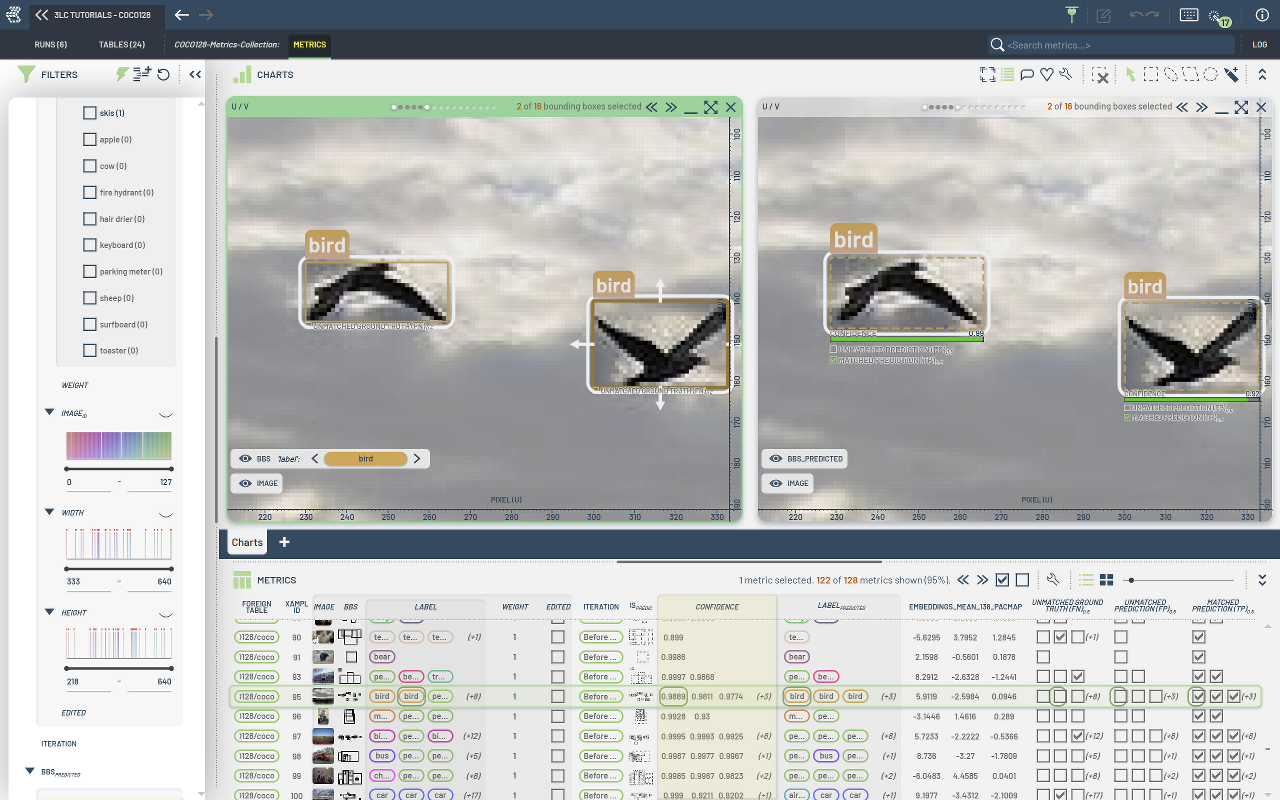
The notebook illustrates:
Metrics collection on a pretrained Detectron2 model using the COCO128 subset.
Using
BoundingBoxMetricsCollectorfor collecting object detection metrics.Collection per-sample embeddings using
EmbeddingsMetricsCollector
Project Setup
[ ]:
PROJECT_NAME = "3LC Tutorials - COCO128"
RUN_NAME = "COCO128-Metrics-Collection"
DESCRIPTION = "Collect bounding box metrics for COCO128"
TRAIN_DATASET_NAME = "COCO128"
TMP_PATH = "../../transient_data"
DATA_PATH = "../../data"
DETECTRON2_MODEL_CONFIG = "COCO-Detection/faster_rcnn_R_50_FPN_3x.yaml"
MAX_DETECTIONS_PER_IMAGE = 30
SCORE_THRESH_TEST = 0.2
ROI_BATCH_SIZE_PER_IMAGE = 512
INSTALL_DEPENDENCIES = True
[ ]:
if INSTALL_DEPENDENCIES:
    # NOTE: detectron2 has no suitable prebuilt wheels for Python 3.10+, so we install from source.
    #       This requires a working C++ compiler and may take a few minutes.
    #       See https://detectron2.readthedocs.io/en/latest/tutorials/install.html for details.
    %env CC=gcc-11
    %env CXX=g++-11
    %pip install -q 3lc[pacmap]
    %pip install -q setuptools standard-pkg-resources wheel ninja
    %pip install -q --no-build-isolation git+https://github.com/facebookresearch/detectron2.git
    %pip install -q opencv-python
    %pip install -q matplotlib
Imports
[ ]:
import random

import cv2
import matplotlib.pyplot as plt
import tlc
from detectron2 import model_zoo
from detectron2.config import get_cfg
from detectron2.data import DatasetCatalog, MetadataCatalog
from detectron2.utils.logger import setup_logger
from detectron2.utils.visualizer import Visualizer

logger = setup_logger()
logger.setLevel("ERROR")
Prepare the dataset
A small subset of the COCO dataset (in the COCO standard format) is available in the ./data/coco128 directory.
It is provided while cloning our repository.
[ ]:
train_json_path = tlc.Url(DATA_PATH + "/coco128/annotations.json").to_absolute()
train_image_folder = tlc.Url(DATA_PATH + "/coco128/images").to_absolute()

assert train_json_path.exists(), "JSON file does not exist!"
assert train_image_folder.exists(), "Image folder does not exist!"
Register the dataset with 3LC
Now that we have the dataset in the COCO format, we can register it with 3LC.
[ ]:
from tlc.integration.detectron2 import register_coco_instances

register_coco_instances(
    TRAIN_DATASET_NAME,
    {},
    train_json_path.to_str(),
    train_image_folder.to_str(),
    project_name=PROJECT_NAME,
    keep_crowd_annotations=False,
)
The detectron2 dataset dicts and dataset metadata can be read from the DatasetCatalog and MetadataCatalog.
[ ]:
dataset_metadata = MetadataCatalog.get(TRAIN_DATASET_NAME)
dataset_dicts = DatasetCatalog.get(TRAIN_DATASET_NAME)
To verify the dataset is in correct format, let’s visualize the annotations of randomly selected samples in the training set:
[ ]:
import numpy as np
from detectron2.utils.file_io import PathManager

for d in random.sample(dataset_dicts, 3):
    filename = tlc.Url(d["file_name"]).to_absolute().to_str()
    if "s3://" in filename:
        with PathManager.open(filename, "rb") as f:
            img = np.asarray(bytearray(f.read()), dtype="uint8")
            img = cv2.imdecode(img, cv2.IMREAD_COLOR)
    else:
        img = cv2.imread(filename)
    visualizer = Visualizer(img[:, :, ::-1], metadata=dataset_metadata, scale=0.5)
    out = visualizer.draw_dataset_dict(d)
    out_rgb = cv2.cvtColor(out.get_image(), cv2.COLOR_BGR2RGB)
    plt.imshow(out_rgb[:, :, ::-1])
    plt.title(filename.split("/")[-1])
    plt.show()
Start a 3LC Run and collect bounding box evaluation metrics
[ ]:
[ ]:
cfg = get_cfg()

cfg.merge_from_file(model_zoo.get_config_file(DETECTRON2_MODEL_CONFIG))
cfg.MODEL.WEIGHTS = model_zoo.get_checkpoint_url(DETECTRON2_MODEL_CONFIG)
cfg.DATASETS.TRAIN = (TRAIN_DATASET_NAME,)
cfg.OUTPUT_DIR = TMP_PATH
cfg.DATALOADER.NUM_WORKERS = 0
cfg.MODEL.ROI_HEADS.BATCH_SIZE_PER_IMAGE = ROI_BATCH_SIZE_PER_IMAGE
cfg.MODEL.ROI_HEADS.NUM_CLASSES = 80
cfg.TEST.DETECTIONS_PER_IMAGE = MAX_DETECTIONS_PER_IMAGE
cfg.MODEL.ROI_HEADS.SCORE_THRESH_TEST = SCORE_THRESH_TEST
cfg.MODEL.DEVICE = "cuda"
cfg.DATALOADER.FILTER_EMPTY_ANNOTATIONS = False

config = {
    "model_config": DETECTRON2_MODEL_CONFIG,
    "model.roi_heads.batch_size_per_image": ROI_BATCH_SIZE_PER_IMAGE,
    "test.detections_per_image": MAX_DETECTIONS_PER_IMAGE,
    "model.roi_heads.score_thresh_test": SCORE_THRESH_TEST,
}

run.set_parameters(config)
[ ]:
from detectron2.engine import DefaultTrainer
from tlc.integration.detectron2 import BoundingBoxMetricsCollector, MetricsCollectionHook

trainer = DefaultTrainer(cfg)

# Define Embeddings metrics
layer_index = 138  # Index of the layer to collect embeddings from
embeddings_metrics_collector = tlc.metrics.EmbeddingsMetricsCollector(layers=[layer_index])

predictor = tlc.metrics.Predictor(trainer.model, layers=[layer_index])

bounding_box_metrics_collector = BoundingBoxMetricsCollector(
    classes=dataset_metadata.thing_classes,
    label_mapping=dataset_metadata.thing_dataset_id_to_contiguous_id,
)

metrics_collection_hook = MetricsCollectionHook(
    dataset_name=TRAIN_DATASET_NAME,
    metrics_collectors=[bounding_box_metrics_collector, embeddings_metrics_collector],
    collect_metrics_before_train=True,
    predictor=predictor,  # Needs to be used for embeddings metrics
)

trainer.register_hooks([metrics_collection_hook])
trainer.resume_or_load(resume=False)
trainer.before_train()
[ ]:
train_table = tlc.Table.from_url(
    dataset_metadata.get("latest_tlc_table_url")
).url  # Get the last revision of the val table

url_mapping = run.reduce_embeddings_by_foreign_table_url(
    train_table,
    method="pacmap",
    n_components=3,
    n_neighbors=5,
)